How We Used AI to Launch a Petition Platform with Relevant Content
Every new community‑driven platform faces the same challenge: users expect to see meaningful activity from day one, but that activity normally appears only after the audience has arrived.
We recently encountered this problem while developing an online petition platform for a client whose name remains confidential under NDA. The product was ready for launch, but an important question remained: how could we populate it with relevant petition ideas before the first users started creating their own?
Manually preparing hundreds of petitions would have been slow and difficult to scale. Instead, we built an AI‑powered content pipeline.
What was the challenge?
Launching the platform with an empty homepage was not an option. It could make a fully functional product feel inactive and give early users little reason to explore it.
At the same time, petition topics could not be generic. They had to reflect real issues affecting communities across different US states. This meant working with large amounts of frequently updated information, including:
- Local news;
- State legislation and newly introduced bills;
- City council agendas;
- Referendums and ballot initiatives;
- Debates about public funding;
- Other socially significant local and statewide issues.
The system also needed to separate meaningful signals from background noise, detect duplicate stories and ensure that nothing was published without human review.
Research came first
Before starting the implementation, we spent approximately two weeks researching available AI tools and testing different approaches.
The main goal was not simply to generate text. We needed to build a reliable process capable of collecting information from multiple sources, understanding what the stories were about, grouping related events and identifying topics that could develop into relevant petitions.
Based on the research results, we selected a combination of AI tools suitable for different stages of the pipeline.
How the system works
The complete workflow consists of five main stages.
1. Collecting local and statewide information
The system gathers news and legislative updates from sources across different US states. This creates a continuously updated dataset covering both local developments and broader statewide issues.
2. Analyzing and cleaning the data
The collected materials are analyzed, filtered and normalized. Duplicate or closely related stories are identified, while irrelevant information is removed.
This step significantly reduces noise and prevents the same event from appearing multiple times simply because it was covered by several sources.
3. Detecting trends
The system then searches the cleaned data for recurring and emerging themes.
These trends may involve proposed state legislation, upcoming city council decisions, referendums, public funding debates or other issues that could affect a significant number of people.
Instead of treating every individual news article as a separate topic, the AI looks for broader patterns across the available information.
4. Generating petition proposals
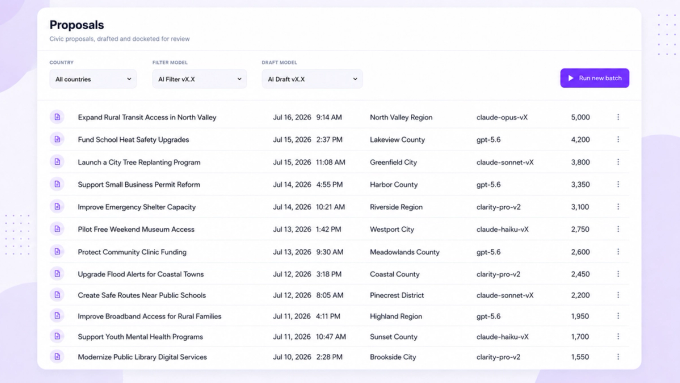
Using the identified trends, our AI bot prepares structured proposals for potential petitions.
The bot does not publish anything automatically. Its job is to transform large volumes of fragmented information into clear drafts that administrators can quickly evaluate.
5. Human review and approval
Every proposal goes through an administrative review. The platform’s administrators can edit, approve or reject each draft before publication.
This human‑in‑the‑loop approach combines the speed and scale of AI with the judgment required for socially significant content.
From research to production in three weeks
The research phase took approximately two weeks. Once we had selected the right tools and validated the approach, the implementation itself took one more week.
The project demonstrated that AI can solve more than conventional content‑generation tasks. With the right architecture and human oversight, it can analyze complex information flows, recognize meaningful trends and help a new product overcome its cold‑start problem.
Have an unusual challenge of your own?
If your business has a non‑standard technical challenge and an off‑the‑shelf solution does not fit, let’s talk. At Afterlogic.Works, we enjoy turning complex ideas into practical, production‑ready systems and we would be happy to find the right approach for yours.