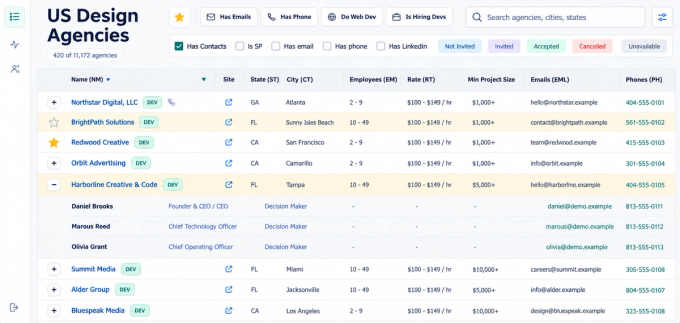
A client came to us to improve their lead generation and outbound sales processes in HubSpot. After analyzing their workflows, we realized that further customization would require too many integrations, workarounds, and compromises. Instead, we built a CRM around the client’s exact business needs.
What the client wanted to improve
The client was already using HubSpot for core CRM and outreach activities. They came to us because they needed to adapt it to a much more specific lead generation and sales process.
The requested customizations included:
- Automated lead discovery and contact enrichment;
- Client-specific qualification and scoring rules;
- Highly customized cold email and follow-up sequences;
- Coordination of email outreach with LinkedIn invitations and conversations;
- Multiple sales funnels with non-standard transition rules;
- Business-specific automation and reporting.
HubSpot already supported many of these capabilities individually. The challenge was combining them into one coherent workflow that precisely matched the client’s sales model.
During the discovery phase, we found that implementing the complete process would require several third-party tools, additional synchronization layers, and compromises with the platform’s existing data model and automation logic.
The key question became: should the client continue adapting their processes to the CRM, or should the CRM be designed around their processes?
Why we decided to build a custom CRM
The client’s competitive advantage was not simply having a database of leads. It was how those leads were discovered, analyzed, segmented, contacted, and moved through the sales funnel.
Together, we decided to develop a custom CRM around these processes — not a generic platform with additional fields, but a system designed specifically for the client’s lead generation, qualification, communication, and sales workflows.
Only a year ago, building a CRM of this scope from scratch would have been a long and expensive project.
Modern AI-assisted design and development tools have changed this. They helped us accelerate business-process modeling, interface design, architecture, implementation, testing, and iteration.
As a result, we delivered the CRM in just six weeks.
What the new CRM does
The system supports the client’s complete outbound sales cycle.
It automatically discovers leads and enriches their profiles with available contact information, including:
- Business email addresses;
- Phone numbers;
- LinkedIn profiles;
- Other relevant social media accounts;
- Company, role, and qualification data.
The CRM combines this information into a single lead profile and connects lead discovery, enrichment, scoring, communication history, follow-ups, pipeline transitions, and internal notifications.
The sales team no longer needs to switch between multiple tools or manually transfer information from one platform to another.
Segmentation beyond standard CRM fields
Traditional CRM segmentation is usually based on criteria such as country, industry, company size, or estimated value. These fields are useful, but they were not enough for this client.
The new system also analyzes the context of each lead: their business profile, likely priorities, language, communication style, and cultural background.
A startup founder in the United States should not necessarily receive the same message as an executive at a traditional company in Germany or a business owner in the Middle East. Even when the offer is identical, the arguments, tone, level of formality, and expected communication style may differ.
This deeper classification allows the client to understand not only who the prospect is, but also how to communicate with them.
Three times higher conversion
More precise segmentation made cold outreach significantly more relevant.
Instead of using broadly personalized templates based on a few standard fields, the client can now prepare messages that reflect the prospect’s role, company, business situation, language, and cultural context.
As a result, cold outreach achieved three times the previous conversion rate from leads to clients.
The improvement came not from sending more messages, but from understanding prospects better and communicating with them more accurately.
Business software should adapt to the business
We are entering a new stage in business software development.
Companies no longer need to spend months learning complex cloud CRM platforms, reorganize their processes around predefined funnels, or accept limitations because custom development is too expensive.
Modern AI-assisted development allows us to build focused business systems faster and at a much more accessible cost.
Instead of choosing a CRM that almost fits your business, you can now create one that precisely matches your goals, workflows, and competitive advantages.
If your current CRM limits your processes — or if you want to explore what a custom system could do for your company — contact us. We will help you design a solution around your real business needs.