AI assistant for a research platform
The more research a platform stores, the more valuable its data becomes — and the harder it can be to use. For LookLook, one of the research platforms we work with, this had become a bottleneck for moderators, especially when they needed to find the right participants for new studies or review large volumes of responses.
Selecting participants often meant searching through previous studies, opening individual messages, reading the context, and manually deciding whether someone matched the criteria. The client wanted to reduce that repetitive work and make participant selection and research analysis more consistent, so we integrated AI directly into the platform.
About client
LookLook is a research company with its own platform for running surveys and working with participants. It allows teams to create participant groups, set up studies, collect responses, and analyze results. The platform stores research history, participant responses, and profiles, which can be used to select audiences and work with findings from previous studies.
Tools
We organized the model’s access to data through separate functions that take user permissions into account. For searching across stored materials, we used OpenSearch so that only the relevant data is passed to the LLM, rather than the entire message history.
Team
The project team included an AI engineer, a QA engineer, and a project manager. They worked out the AI logic, tested the key user scenarios, and ensured the solution was implemented consistently.
What we did
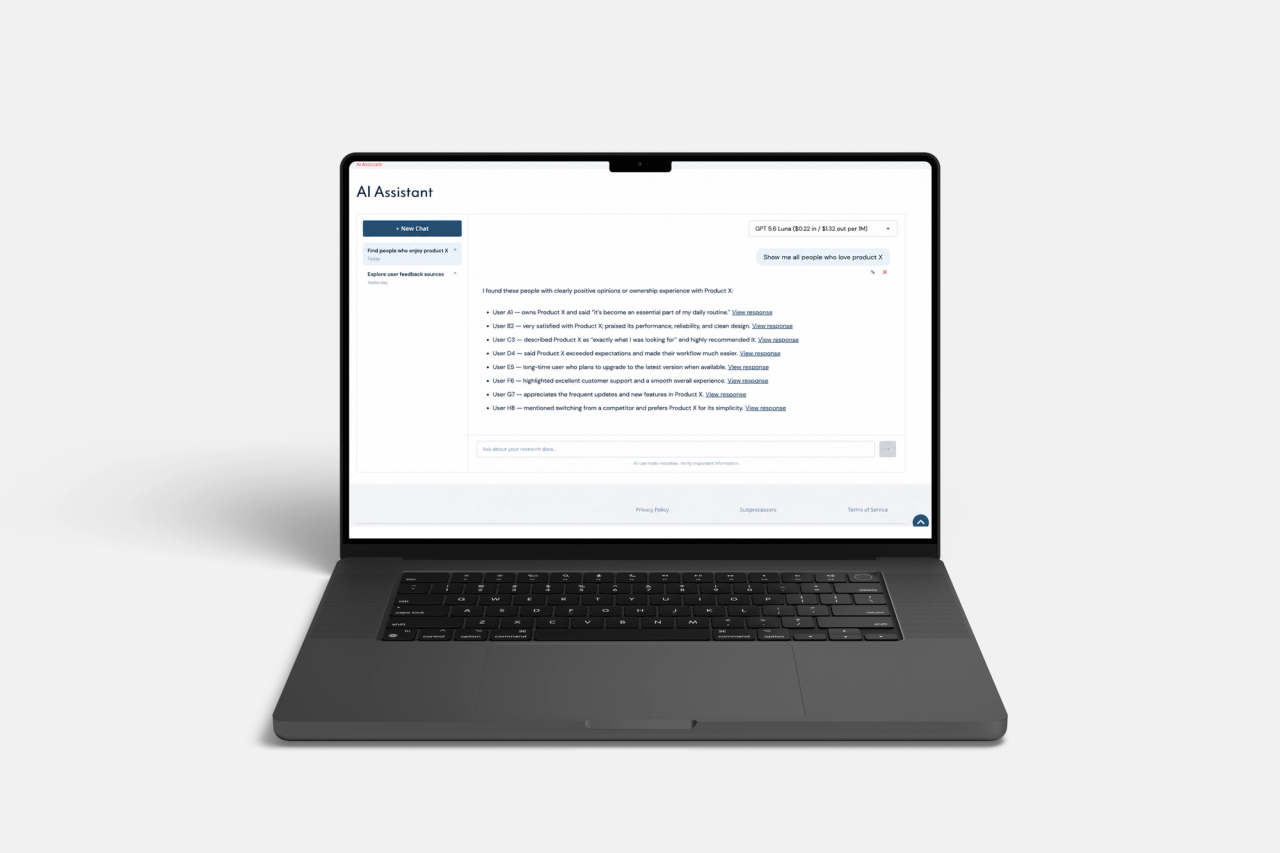
Natural language search and analysis A moderator can describe a task in plain language: find participants with specific experience, review what a particular person said in previous studies, or prepare a summary of collected materials.
Queries can be written in different languages, so responses from multilingual studies do not require separate workflows for each language.
Role‑based access The platform uses role‑based permissions. For example, an administrator may have access to more participant data than a moderator. In this setup, giving the language model direct access to the entire database was not an option.
Instead, data is requested through separate tools for studies, participants, groups, and messages. Every request respects the user’s permissions: if information is not available to them in the standard interface, it is not exposed through AI either.
Working with large volumes of data Sending the entire message history to the model with every request would be unnecessary. OpenSearch first selects the relevant materials, and only then are they passed to the LLM.
This keeps the model focused on a narrower context while keeping data volume and token usage under control.
Source verification The results are not a “black box.” If a conclusion is based on a specific participant message, the moderator can open it and review the original context.
AI helps find relevant information faster and bring it together, while the source data remains available for verification before any decision is made.
Result
Instead of going through research history step by step, a moderator can start with a natural language query and go straight to the relevant participants, responses, or summary.
At the same time, the AI works within the existing role‑based access model, and the results can be checked against the original messages. This makes the process easier for the team without reducing control over data access.